Structure and transmission principle of planetary gear reducers
**Structure and Transmission Principle of Planetary Gear Reducers**
A planetary gear reducer is a compact, high‑torque‑density drive that splits load
over multiple planet gears. Understanding its internal architecture and power flow
is the foundation for accurate sizing, low‑backlash integration, and reliable service.
Here is a concise, engineer‑focused breakdown.
**Core Components**
A single planetary stage consists of four elements:
- **Sun gear** – the central input gear.
- **Planet gears** – typically three to six identical gears rotating around the sun.
- **Ring gear (annulus)** – an internal‑tooth gear enclosing the planets.
- **Planet carrier** – the rigid structure that holds the planet pins and serves
as the output member.
All planet gears mesh simultaneously with the sun and ring gear, creating multiple
power paths. This inherent load sharing is what gives planetary stages
their exceptional torque density.
**Transmission Principle**
In the most common configuration (sun input, fixed ring gear, carrier output):
1. The motor drives the sun gear at high speed and low torque.
2. The sun gear forces the planet gears to roll along the stationary ring gear.
Each planet rotates on its own axis while the whole set revolves around
the sun – exactly like a planetary system.
3. The planet carrier, driven by the orbital motion of the planets, rotates
in the same direction as the sun but at a drastically reduced speed.
The single‑stage reduction ratio is defined by:
**i = (Z_ring + Z_sun) / Z_sun**
where Z_ring is the number of ring gear teeth and Z_sun is the sun gear teeth.
A ring with 63 teeth and a sun with 18 teeth yields a ratio of (63+18)/18 = 4.5:1.
Because the load is distributed over multiple gear meshes simultaneously,
torque capacity per unit volume is far higher than a simple parallel‑shaft pair.
**Why Planetary Design Wins**
- **High torque density** – multiple planet contacts minimize tooth forces.
- **Low backlash** – helical planet gears and precision
grinding achieve ≤1‑3 arc‑min, ideal for servo applications.
- **High efficiency** – 92–97% per stage when gears are well lubricated.
- **Coaxial layout** – input and output share the same centre line, simplifying machine design.
- **Scalability** – multiple stages can be stacked in series for ratios up to several hundred.
**Common Variants**
- **In‑line planetary** – sun input, carrier output, ring fixed.
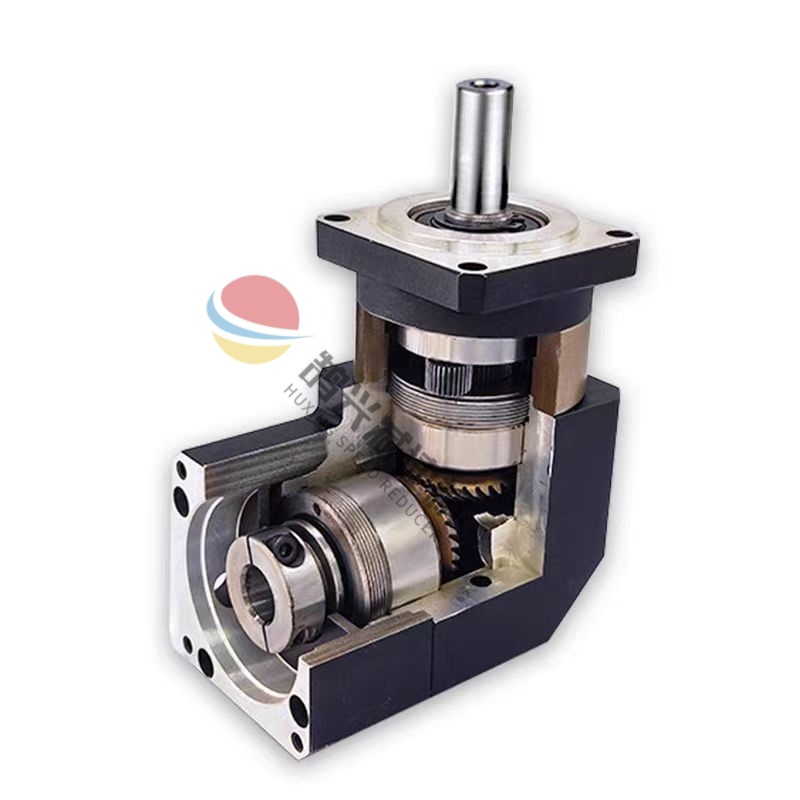
- **Right‑angle planetary** – uses spiral‑bevel or hypoid input before the planetary stage.
- **Differential planetary** – both ring gear and carrier can be driven/braked, enabling compound motion.
**Need Help Specifying a Planetary Reducer?**
Correctly matching ratio, backlash class, and frame size requires experienced calculation.
As a professional gearbox manufacturer, we offer standard and custom planetary gear
reducers – from compact servo units to heavy‑duty industrial drives.
**[Contact our engineering team]** with your torque, speed, and precision requirements,
and we will recommend a configuration that guarantees both performance and cost efficiency.