What Is a Double Stage Worm Gear Reducer?
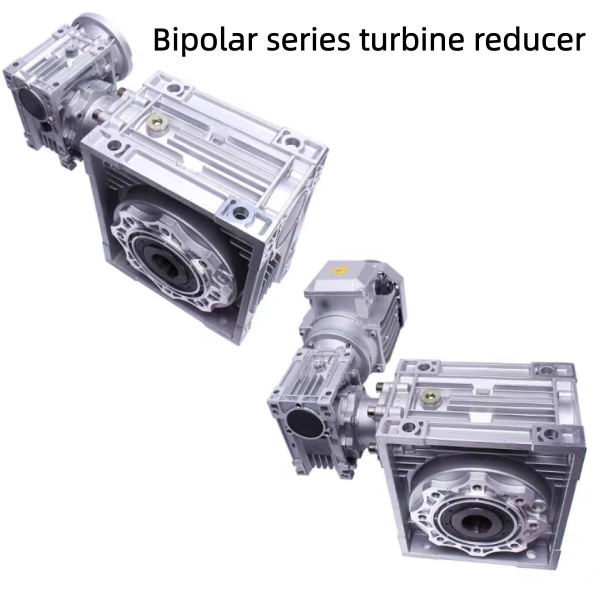
A double stage worm gear reducer (also called a dual-stage or two-stage worm gearbox) consists of
two worm gear stages connected in series:
Common combinations include: NMRV25/30, 25/40, 30/40, 30/50, 30/63, 40/75, 40/90, 50/110,
63/130, and 63/150. You can mix and match any two NMRV sizes from 025 to 150 to achieve your
exact ratio requirement.
Core working principle of bipolar turbine reducer
It is a transmission device that integrates two single-stage NMRV worm gear reduction units in series, and the power is sequentially reduced through two-stage worm gear pairs from the input end:
Level 1: Adapted to the North American standard of 1750RPM NEMA motor input power, the first set of worm gears is used to complete the initial deceleration, reducing the high speed to the medium low speed range.
Second stage: The initially reduced power is transmitted to the second set of worm gear pairs through a built-in rigid coupling, completing a large reduction ratio deceleration again, and ultimately outputting high torque power as low as 1.75-17.5RPM.
This structure retains a 90 ° right angle input/output layout, and the combination of two-stage worm gear pairs can achieve a super full coverage speed ratio of 100:1~1000:1. At the same time, it comes with dual reverse mechanical self-locking characteristics, suitable for low-speed and heavy-duty working conditions.