
How to Select a Medium Gear Motor – A Complete Sizing & Selection Guide for Engineers
How to choose a medium-sized gear motor - Engineer's complete size and
selection guide
Gear motors combine electric motors and gearboxes into a factory tested unit that provides high torque
at low speeds. Choosing the appropriate medium-sized gear motor for your application is crucial: motors
that are too large in size can increase unnecessary costs, while motors that are too small in size may
overheat, cause premature gear wear, or completely fail.
This guide provides a structured and step-by-step approach for engineers and procurement professionals
to identify and select medium-sized gear motors, particularly the CH, CV, GH, and GV series
H2: Step 1 – Define Your Application Requirements
Before calculating any numbers, clearly define what your application demands. Answer these questions:
| Category | Questions to Ask |
| Load | What is the driven load? (conveyor, mixer, lift, pump, etc.) What is the total mass? Is the load constant or variable? |
| Speed | What output speed (RPM) does your equipment require? |
| Duty Cycle | Continuous (24/7), intermittent, or frequent start/stop? |
| Environment | Operating temperature? Dust, moisture, or washdown conditions? |
| Mounting | Horizontal (floor) or vertical (flange) installation? Available space? |
| Power Source | Voltage, frequency, single-phase or three-phase? |
Why this matters: A conveyor that starts under load, climbs an incline, or handles variable bulk material has very different torque requirements than a lightly loaded, steady-speed belt. Documenting these inputs upfront prevents costly mis-selection.
H2: Step 2 – Calculate Required Output Speed & Reduction Ratio
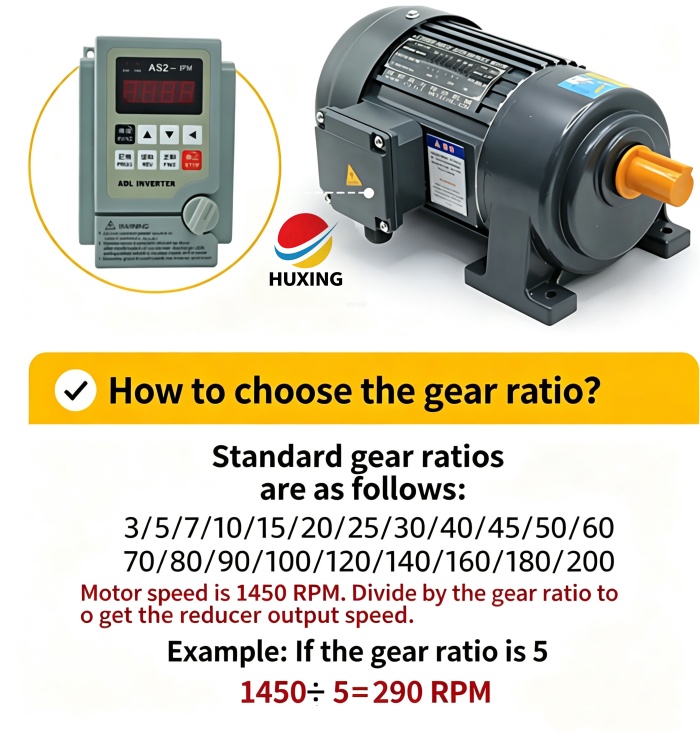
The reduction ratio determines how much the motor’s high speed is reduced to match your equipment’s required speed.
Formula:
Reduction Ratio (i) = Motor Input Speed ÷ Required Output Speed
Example:
Motor rated speed: 1400 RPM (50Hz)
Equipment required speed: 50 RPM
Reduction ratio = 1400 ÷ 50 = 28 : 1
Select the nearest standard ratio (e.g., 30 :1)
Key Principle:
Higher reduction ratio = lower output speed + higher output torque
Lower reduction ratio = higher output speed + lower output torque
Standard ratios for CH/CV/GH/GV series range from 3 : 1 to 1800 : 1.
Do you need dimension drawings and 3D models, product catalogs, or customized scale quotations? Please fill in the required model, power, and installation type, and our engineers will reply to you within 24 hours.