
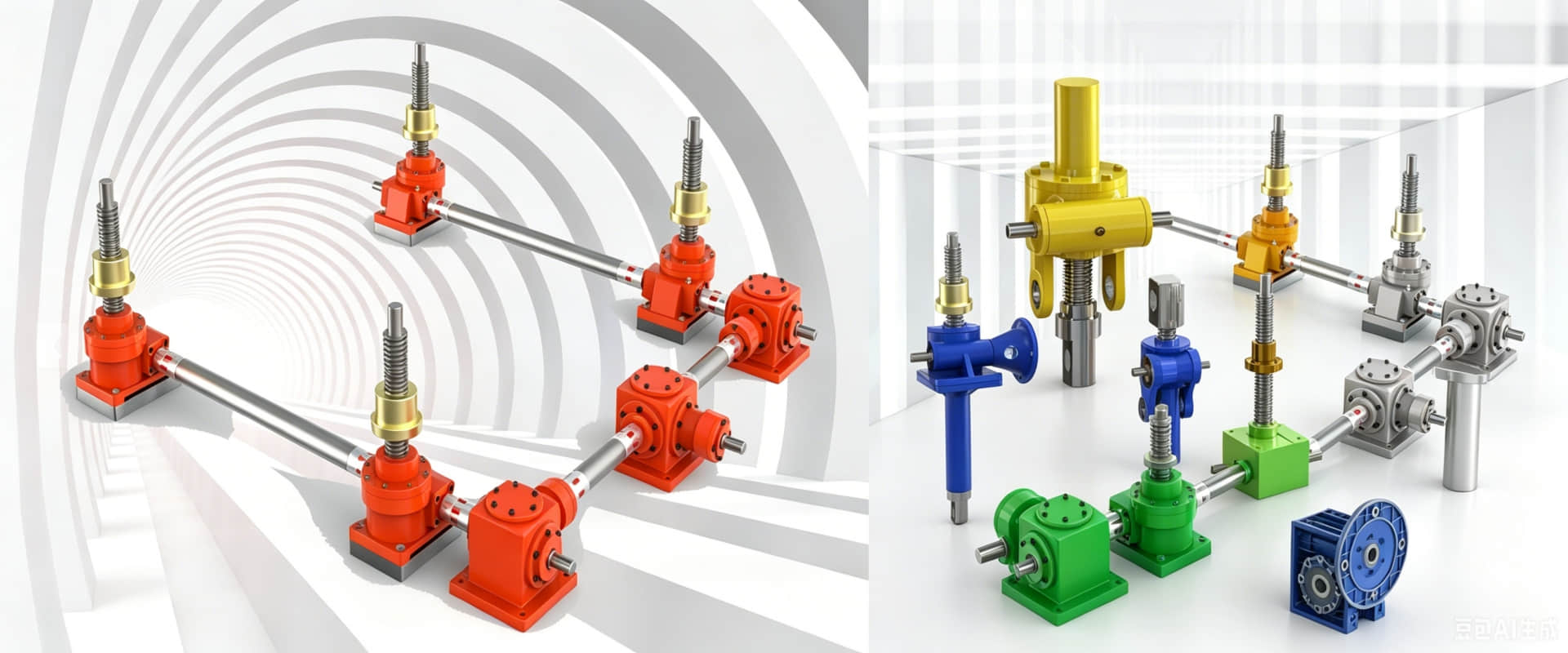
Hollow shaft (RC) and solid shaft (RT) right angle gear motor
Hollow Shaft (RC) vs Solid Shaft (RT) Right Angle Gear Motors: Which One Should You Choose?
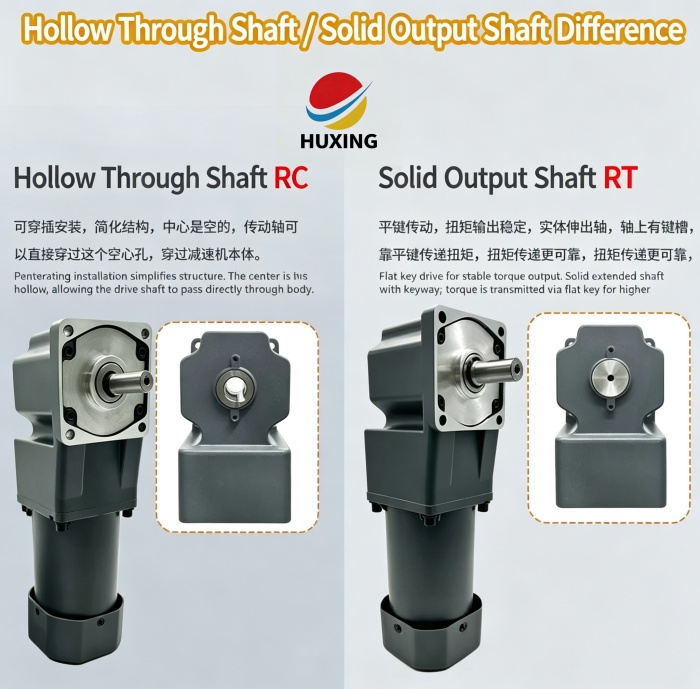
1.Hollow shaft (RC) gear motor — 中空贯穿轴
The RC configuration features a hollow bore that runs completely through the gearbox output shaft.
Key Features (Based on Product Data):
Through-Shaft Mounting: The driven shaft can pass directly through the hollow bore of the gearbox, extending through the entire gearbox body.
Simplified Structure: Eliminates the need for couplings, chains, or external sprockets.
Space Saving: Significantly reduces the axial length of the drive assembly.
No Keyway Required: Relies on clamping elements or shrink discs for torque transmission.
solid output shaft gear motor How It Works:
The RC type is designed for direct mounting. The driven roller or shaft inserts directly into the hollow bore. This design is highly effective for conveyor rollers where the motor needs to be mounted at a 90° angle without taking up extra lateral space.
2. Solid Output Shaft (RT) — 中实输出轴
The RT configuration features a solid, protruding shaft with a standard keyway.
Key Features (Based on Product Data):
Keyway Transmission: Uses a standard flat key to transmit torque from the motor to the driven load.
Stable Torque Output: The solid shaft provides a robust, rigid connection.
Anti-Slip Design: The keyway ensures reliable torque transmission without slipping, even under high loads.
Protruding Shaft: The shaft extends outward, making it easy to attach pulleys, sprockets, or couplings.
How It Works:
The RT type relies on a traditional mechanical interface. Torque is transferred through the keyway and flat key. This is the standard method for connecting to belt drives, chain drives, or geared couplings.
3. Direct Comparison: RC vs RT
| Feature | Hollow Through Shaft (RC) | Solid Output Shaft (RT) |
|---|---|---|
| Shaft Type | Hollow bore (through hole) | Solid protruding shaft |
| Torque Transmission | Clamping / Shrink Disc | Keyway & Flat Key |
| Mounting Method | Directly onto driven shaft | Coupling, pulley, or sprocket |
| Space Saving | Excellent (no extra parts) | Moderate |
| Slip Risk | Low (if properly clamped) | Extremely Low (keyed) |
| Alignment | Simple (self-aligning) | Requires careful alignment |
| Radial Load Capacity | Limited without extra support | High |
| Best For | Conveyor rollers, compact drives | Belt/chain drives, high torque |
Q1: Can I replace an RC gearbox with an RT gearbox on the same motor?
A: Yes. If the motor frame size and mounting flange match (e.g., 90mm frame), you can swap a 6GU-3RC gearbox for a 6GU-3RT gearbox. However, you will need to modify the driven side to accept a keyed shaft and coupling.
Q2: Does the RC hollow shaft require a keyway?
A: No. The RC type typically uses a clamping ring, shrink disc, or friction locking assembly to secure the driven shaft. This eliminates backlash and allows for infinite angular positioning.
Q3: Which type is better for high-torque applications?
A: The RT (Solid Shaft) type is generally preferred for very high torque applications because the keyway provides a mechanical, positive lock that is less prone to slipping than friction-based clamping.
Q4: Can I use an RC gearbox without a through-shaft?
A: Yes. You can insert a stub shaft into the hollow bore if you only need a solid output, but this defeats the primary space-saving purpose of the RC design.
Q5: Are both types available with brakes?
A: Yes. Electromagnetic brakes can be added to the motor (M suffix) regardless of whether the gearbox is RC or RT.
Need Help Selecting the Right Shaft Configuration?
Whether you need a hollow through shaft for a space-saving conveyor or a solid keyway shaft for a high-torque belt drive, our application engineers can help you calculate the required torque, select the correct gear ratio, and choose the right output interface.