helical gearbox vs bevel gearbox
Helical Gear Reducers vs. Bevel Gear Reducers: A Professional Choice Between Parallel Shafts
and Right-Angle Shafts
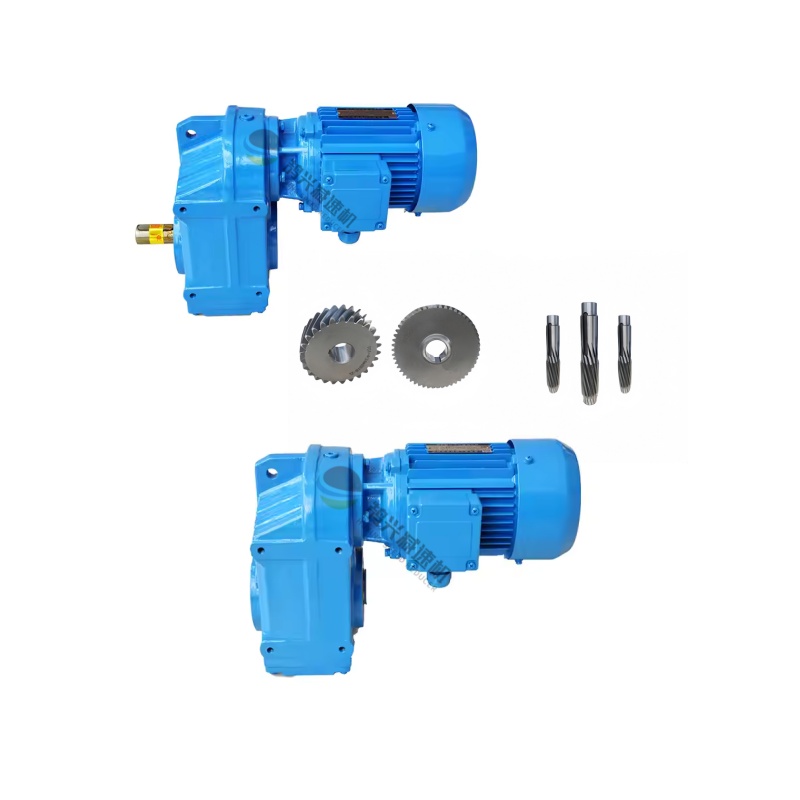
Helical gears and bevel gears are the two most common transmission
forms in industrial reducers.
The former represents efficient parallel shaft transmission, while the latter represents
compact right-angle reversing.
Their structural principles and application scenarios are completely different,
and the selection directly determines
the spatial layout, transmission efficiency, and service life of the equipment.
I. Transmission Direction
This is the most intuitive difference. Helical gear reducers have parallel input and
output shafts, suitable for linear
layouts, with the motor and driven machine mounted coaxially or parallel.
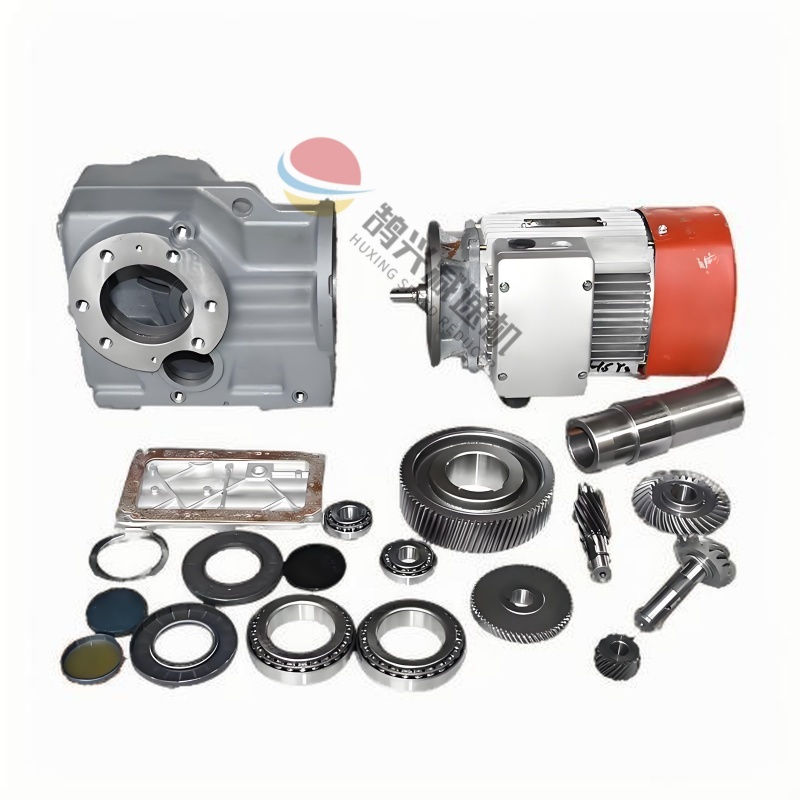
Bevel gear reducers
(including spiral bevel gears) achieve 90° right-angle reversing, allowing
for changes in power flow in confined spaces,
eliminating the need for couplings or idler gears, resulting
in a more compact structure.
II. Efficiency and Load Capacity
Helical gears involve pure rolling meshing, with a long tooth contact line,
achieving a single-stage efficiency of 96–98%,
and extremely high load capacity, making them the first choice for continuous
heavy-duty conveyor lines. Spiral bevel gears,
after grinding, can also achieve an efficiency of 94–97%, but straight bevel gears
have slightly lower efficiency and higher
noise at high speeds. For the same volume, helical gears have a slightly
higher torque density.
III. Noise and Stability: The helix angle of helical gears allows for progressive
meshing of the tooth surfaces, resulting in less impact,
smoother operation, and noise levels typically below 75dB. Bevel gears, especially
straight bevel gears, experience greater meshing impact,
leading to significantly increased noise at high speeds. However, precision-ground
helical bevel gears have achieved a smoothness
approaching that of helical gears, meeting the requirements of
most industrial applications.
IV. Cost and Maintenance: Helical gearboxes have a simple structure, fewer parts,
lower manufacturing costs, and are easy to maintain.
Bevel gears require mating grinding of the tooth contact area, demanding
high machining and assembly precision,
resulting in costs 20-50% higher than helical gears. Furthermore, axial
thrust requires special bearing configurations,
and they are more sensitive to lubrication.
V. Typical Applications:
Helical Gear Reducers: Ideal for parallel shaft applications such as conveyor belts,
agitators, pumps, fans, and extruders,
especially suitable for continuous heavy loads.
Bevel Gear Reducers: The first choice for applications with limited space, such as roller
conveyors, mixing tanks, port machinery,
and automated production lines where power turns are required.
For linear layouts, prioritizing ultimate efficiency and low cost, choose helical gear reducers.
For confined spaces requiring a change in transmission direction, choose bevel gear reducers,
prioritizing spiral bevel gears to balance noise and efficiency.
We offer a full range of helical and spiral bevel gear reducers, as well as
K-series right-angle geared motors.
Unsure about your layout? Submit your space dimensions, torque, and speed
ratio requirements to our engineers
and we will recommend the most cost-effective transmission combination.
Contact our technical team for one-on-one selection and quotation.