
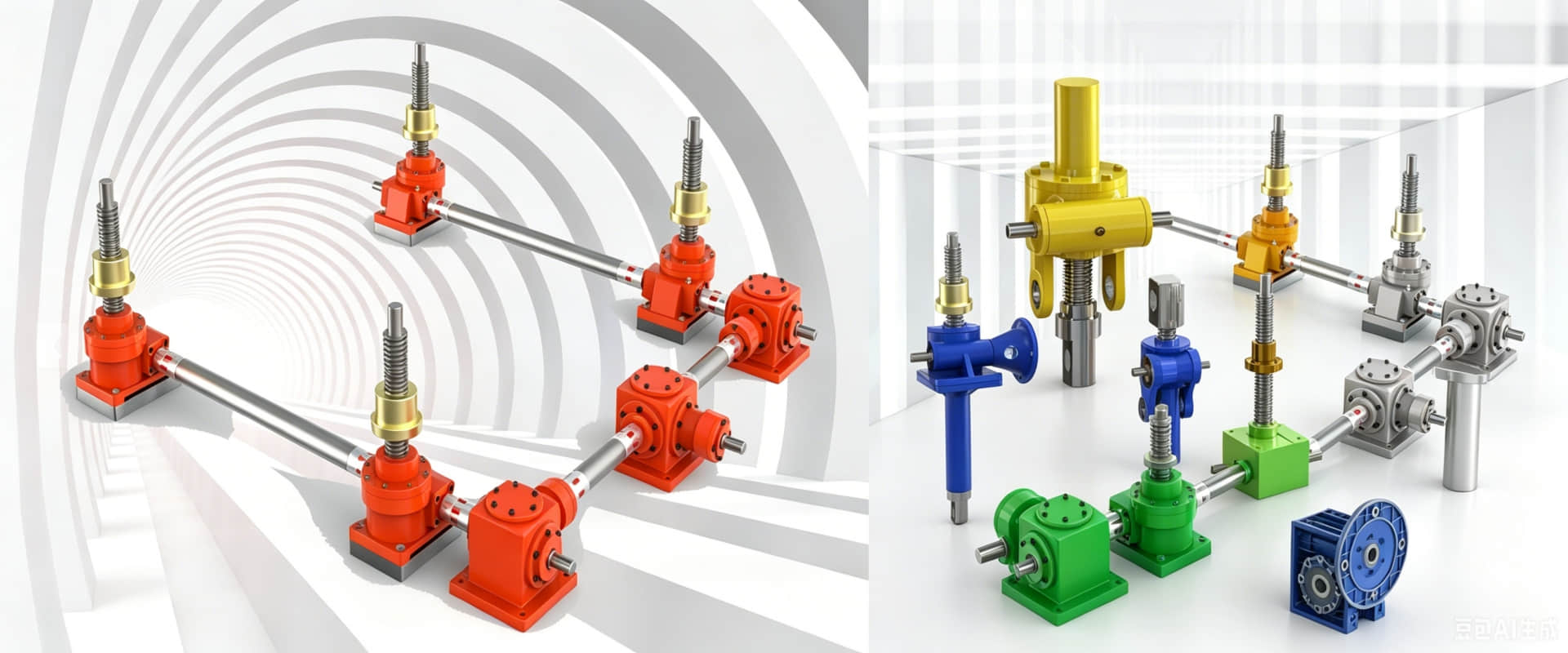
gearmotor sizing formula and selection guide
Gear Motor Selection Formulas and Practical Selection Guide (with Calculation Steps)
The core of gear motor selection is to reliably drive the load with the smallest size and cost.
Choosing a motor that is too small will burn out, while choosing one that is too large will waste money.
The following formulas and steps are directly applicable to engineering calculations, avoiding unnecessary work.
I. Three Core Formulas You Must Master
1. Load Power Formula
[ P = T × n 9550]
- **P** = Power (kW)
- **T** = Required torque at the load end (Nm)
- **n** = Load end speed (rpm)
- 9550 is a unit conversion constant.
**2. Speed Ratio Calculation**
[ i = n_{motor}}}{n_{load}}}
Select the number of pole pairs of the motor (e.g., 4 poles ≈ 1450 rpm),
divide by the target output speed to obtain the required reduction ratio.
Round the speed ratio to the standard gear (e.g., 5, 10, 15, 20...).
**3. Motor-side Torque Verification**
[T_{\text{motor}} = \frac{T_{\text{load}}}{i \times \eta}
- **η** = Reducer efficiency (helical gear ≈ 0.94, planetary gear ≈ 0.92, worm gear ≈ 0.6-0.8)
- The rated torque of the selected motor must be greater than this value;
otherwise, a larger frame size is required.
II. Service Factor: Selecting the Fuse
Using the torque calculated directly from the formula for fuse selection
will likely result in a short lifespan. Must be multiplied by the service factor SF:
**Required rated torque of the reducer ≥ T_load × SF**
SF value reference:
| Load type | Daily operating time | SF |
|----------|--------------|----|
| Stable (belt conveyor) | <8h | 1.0 |
| Moderate impact (mixer, crane) | 8-16h | 1.25-1.5 |
| Severe impact (crusher, punch press) | 24h | 1.75-2.5 |
**Remember: It's better to choose a higher SF value than to take a chance.
** The cost of a reducer is far lower than the loss due to downtime.
III. Inertia Matching Verification (Required for Servo Applications)
For servo systems requiring frequent starts and stops and precise control,
the following must be met:
[ \frac{J_{\text{load}}}{J_{\text{motor}} \times i^2} \leq \text{Allowable Inertia Ratio}
- **High Dynamic** (Robots, Pick-and-Place Machines): Inertia Ratio ≤ 3:1
- **Medium Dynamic** (Machine Tool Feed, Packaging Machines): Inertia Ratio ≤ 5:1
- **Normal Speed Regulation**: ≤ 10:1
If these requirements are not met, **prioritize increasing the reduction ratio
** (inertia conversion is inversely proportional to i²), which is the most economical
adjustment method.
IV. Practical Selection Steps (Quick Reference Table)
| Steps | Operation Content | Output |
| 1 | Determine load torque T, speed n, and installation space | Basic parameters |
| 2 | Calculate load power P, initially select motor pole number | Motor type, power |
| 3 | Calculate speed ratio i = n_motor / n_load | Calibrate speed ratio |
| 4 | Determine service factor SF | Corrected torque |
| 5 | Check if motor T_motor meets requirements | Motor frame size |
| 6 | Servo application checks inertia ratio | Does the speed ratio need adjustment? |
| 7 | Confirm installation method, output shaft, brake, etc. | Complete model number |
| 8 | Verify thermal power: Ensure P ≤ reducer heat capacity for continuous operation | Overheat protection |
V. Common Selection Misconceptions
- Focusing only on power while ignoring torque: Gearbox failure often begins with insufficient torque.
- Ignoring ambient temperature: High-temperature environments require derating, and oil seal material must be matched.
- Replacing helical gears with worm gears without adjusting SF: For the same power, worm gears should be 1-2 size larger.
- Using only planetary gears for servo motors: Helical gears + servo motors offer better
cost-effectiveness for many medium-speed applications.
Need professional selection support?
Send our engineers your load type, required torque, speed, running time, and installation sketches.
We will return a **complete selection report** within 24 hours, including efficiency curves,
inertia calculations, and installation dimensions. From standard products to non-standard modifications,
we provide one-stop solutions.
Contact the Huxing technical team now for a one-on-one geared motor selection solution and quote.