
Calculate the torque and inertia required for a ball screw drive to power a load.
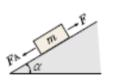
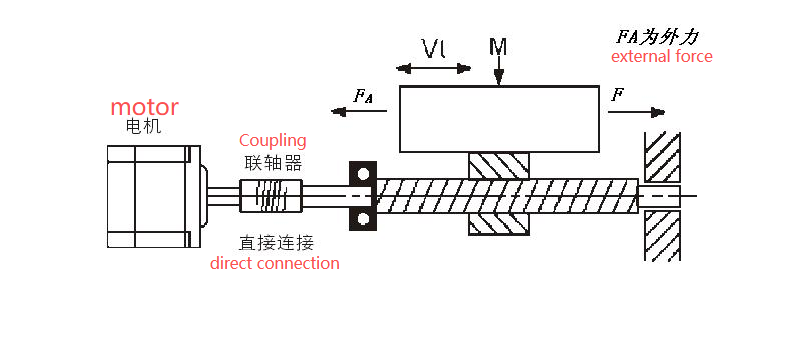
M = Mass of the load (kg), μ is the coefficient of friction (0.1),
α is the angle between the direction of movement and the horizontal direction.
fa is the external force, P is the lead screw (m).
The force required to move the object is F = fa + mg(sinα + μcosα), in Newtons (N). g = 9.8 N/kg.
The load operating torque is T = Fx (N·m),
in Newton-meters (N·m). Transmission efficiency: η is the lead screw transmission efficiency.
The required output torque of the reducer is T2 = Txk/η2. k is a safety factor, generally 1.5-3,
determined based on the equipment's operating conditions, type of equipment, impact forces, duty cycle, etc.
η2 is the transmission efficiency of the geared motor. Regarding inertia calculation:
Total load inertia = Screw inertia + Load inertia + Coupling inertia
Motor inertia (can be found by consulting motor parameters)
Inertia ratio = Total load inertia / Motor inertia
Motor starting torque = Rotational inertia x Angular acceleration =
(Total load inertia + Motor inertia) x Angular acceleration
Two formulas for calculating motor starting torque:
1. Motor starting torque = Rated motor torque x K (K is taken as 1.5-2)
2. Motor starting torque = Rotational inertia x Angular acceleration M = J x α
Angular acceleration α = Δω / Δt, equivalent to (Final speed - Initial speed) x 2π / Starting time
If you have any questions or difficulties regarding the selection of reducers or motors,
please feel free to contact us! Huxing Gear Motor - Professionalism Creates Infinite Possibilities!