gear motor working principle explained
Gear Motor Working Principle: A Simple and Intuitive Engineering Breakdown
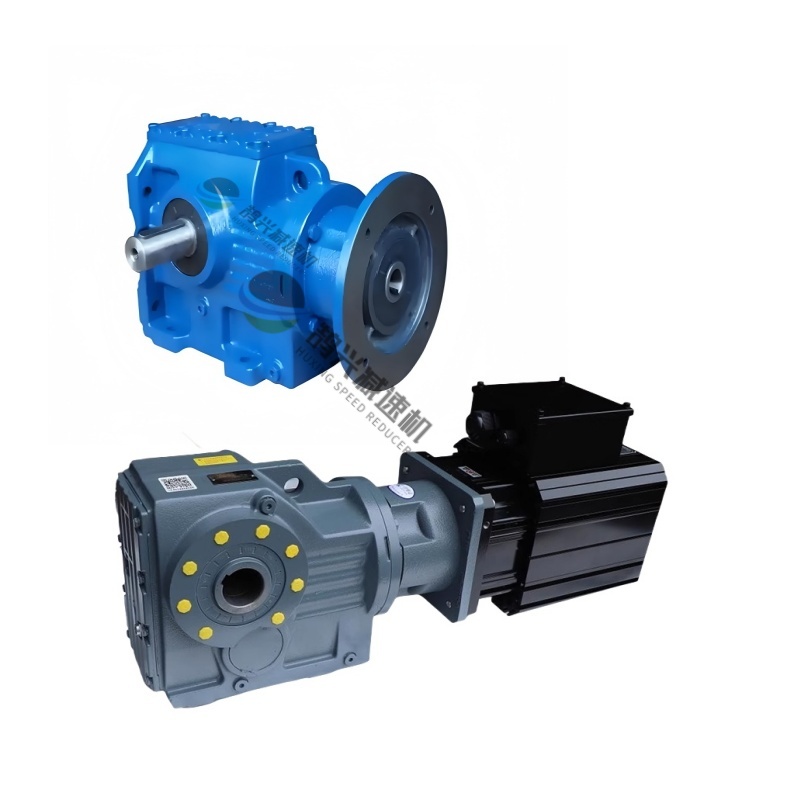
A gear motor is a drive unit that integrates a gearbox into a regular motor.
It doesn't change the basic electromagnetic principles of a motor, but rather uses
the mechanical magic of gears to convert high-speed, low-torque input into low-speed,
high-torque output while matching inertia. To understand its principle, you only need to
grasp one core law and three key processes.
Core Law: Power Conservation
Under ideal conditions where friction losses are negligible, a gear motor follows:
Power (P) = Torque (T) × Speed (n) / Constant
When the gearbox reduces the speed, the torque is proportionally amplified. A small
3000rpm motor,
after passing through a gearbox with a reduction ratio of 10:1, will have its output
speed reduced to 300rpm,
theoretically increasing the torque tenfold.
Three Key Processes
1. Motor Side: Electrical Energy → Mechanical Energy
Current flows into the stator windings, generating a rotating magnetic field
(AC induction or permanent magnet synchronous), driving the rotor to rotate.
At this stage,
the speed is high and the torque is low; direct use is insufficient to drive heavy loads.
2. Gearbox Side: Speed Reduction and Torque Increase
The motor output shaft connects to a small gear (driving gear), which meshes with
a large gear (driven gear).
Depending on the gear ratio, the small gear rotates multiple times for the large
gear to rotate only once.
Each meshing stage is a "speed for torque" trade-off:
First stage: Small gear has 10 teeth, large gear has 50 teeth, speed ratio 5:1,
speed drops to 1/5,
torque increases 5 times.
Multi-stage series: Multiple gear pairs are stacked, speed ratios are multiplied,
torque multiplication is even
more significant, often reaching hundreds or even thousands of times.
3. Inertia Matching: The Most Easily Overlooked Key Parameter in Gear Motor Selection
Even if the torque, speed, and power of the gear motor are calculated correctly,
the equipment may still experience severe
vibration, positioning overshoot, inaccurate displacement positioning, or even
fail to start—nine times out of ten,
it's due to inertia mismatch. This is a core indicator as important as torque
in servo system design, yet it is often overlooked.
I. What is Inertia Matching?
Inertia is a measure of an object's resistance to changes in rotational speed.
The motor rotor has its own inertia (Jm),
and the load end (workbench, robotic arm, turntable, etc.) has load inertia (JL).
The inertia ratio is the ratio of the load
inertia referred to the motor shaft to the motor rotor inertia, which must be controlled
within a reasonable range. If the ratio
is too large, the system response will be sluggish or experience uncontrolled oscillations;
if the ratio is too small,
the motor's capacity will be wasted.
II. The Inertia Reduction Effect of Gearboxes
This is the most ingenious aspect of inertia matching in gearbox selection.
When the load inertia is referred to
the motor shaft through the gearbox, it follows this rule:
Referred Inertia = JL / i² (where i is the reduction ratio)
A gearbox with a 10:1 speed ratio will reduce the load inertia referred
to the motor end by a factor of 100.
This is the mathematical essence of how a high reduction ratio significantly improves
inertia matching and
enhances system controllability. Without a gearbox, directly driving a large inertia load
would be difficult for the motor and drive unit to handle.
III. Consequences of Mismatch
**Ratio Too Large (>10-20 times):** The motor cannot handle the load start/stop,
response is slow,
positioning overshoot occurs and oscillations occur, requiring significant
speed reduction to stabilize.
**Ratio Too Small (<1 times):** The motor has excessive capacity, resulting in wasted cost,
and transmission
chain stiffness issues can easily lead to high-frequency vibration.
**Typical Fault Symptoms:** Servo alarms (overload, excessive deviation),
frequent coupling breakage,
premature gear pitting.
The reduction ratio is the most effective lever for adjusting the inertia ratio.
Choosing a larger reduction ratio
can effectively reduce the equivalent inertia, but it will sacrifice output speed;
a trade-off
must be made between speed and inertia.
V. Inertia Matching Selection Steps
Calculate the equivalent load inertia of the mechanical system referred to the motor
shaft (including the reducer, coupling, and load).
Initially select the motor and read the rotor inertia value.
Calculate the inertia ratio and determine whether it is within the recommended range
according to the table above.
If the requirements are not met, prioritize adjusting the reduction ratio
(increasing the ratio reduces the equivalent inertia),
or replace with a motor with one having greater inertia.
Verify if the system meets the acceleration requirements.
Need inertia matching support?
Our engineers can accurately calculate the inertia conversion and
recommend the optimal reduction ratio to ensure
fast and stable equipment response. Provide us with your load parameters,
acceleration, and installation method
to receive a precise selection solution.
Common Gear Types and Principle Differences
Parallel Shaft Helical Gears: Progressive tooth meshing, smooth and quiet transmission,
extremely high efficiency,
suitable for continuous heavy loads.
Worm Gears: 90° right-angle transmission, sliding friction, self-locking characteristic,
suitable for anti-reverse scenarios.
Planetary Gears: Multiple planetary gears share the load, compact size,
extremely low backlash,
suitable for servo precision control.
Regardless of the gear type, the essence is to use a mechanical structure to
convert the "speed" of the motor into the
"force" of the equipment. Choosing the right reduction ratio and gear type
allows you to drive the largest load
with the smallest motor.
Need selection support? Our engineers can quickly match the optimal geared motor
solution based on your load torque,
output speed, and installation space.