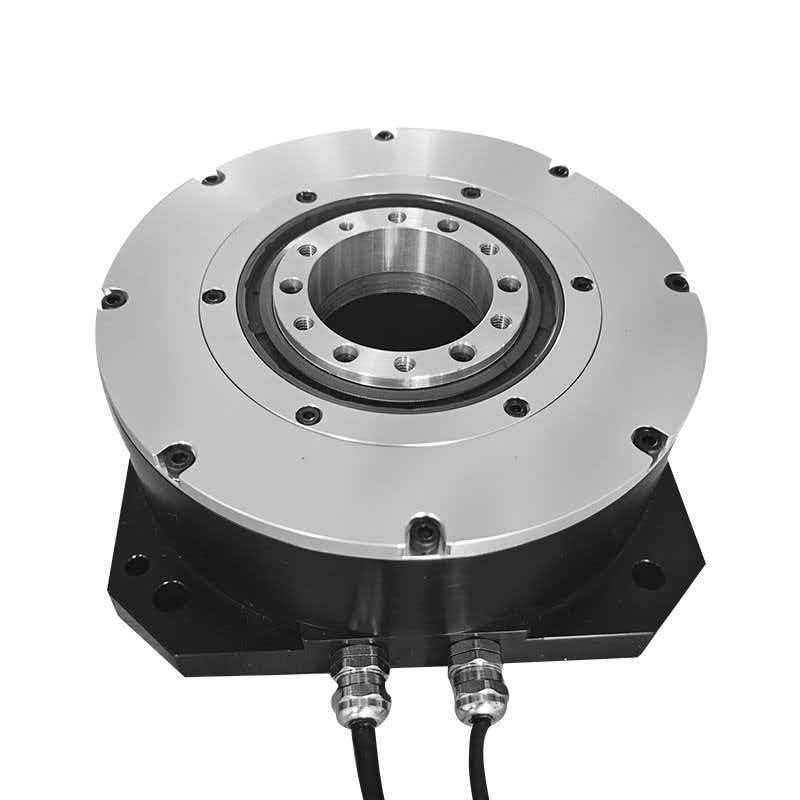
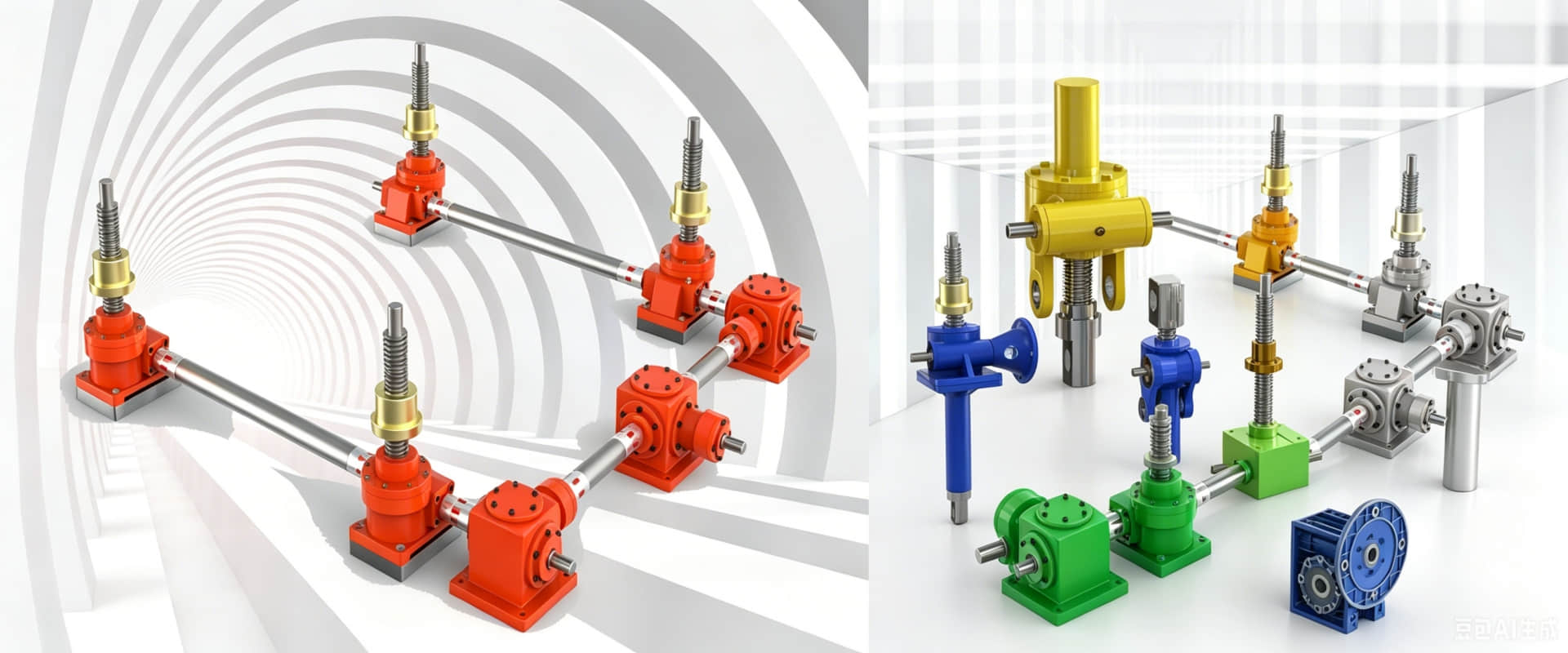
gear motor vs direct drive motor
Geared Motors vs. Direct Drive Motors: The Trade-off Between High Torque and High Precision
In power transmission selection, the ultimate question is whether to use a geared motor or a direct drive.
Geared motors amplify torque and reduce speed through a gearbox; direct drive motors eliminate
mechanical transmission, with the rotor directly driving the load. They represent fundamentally
different design philosophies, with no absolute superiority or inferiority, only suitability for specific scenarios.
I. Torque Density and Inertia Matching
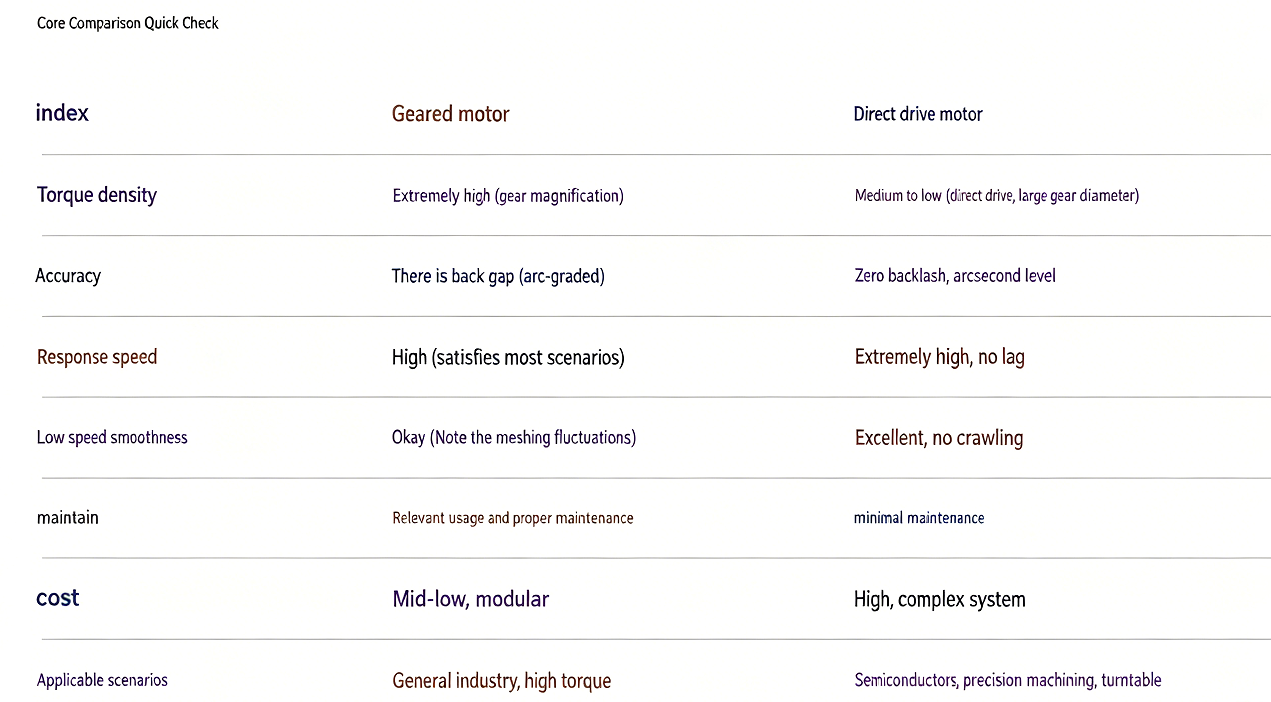
Geared motors, through gear ratio amplification, easily output thousands of Newton-meters of torque and
effectively balance the inertia of the motor and load, ensuring system stability. Direct drive motor torque
relies entirely on electromagnetic force; achieving high torque requires increasing the diameter and current,
typically resulting in a bulky size. For low-speed, high-torque applications, geared motors
win in terms of compactness and cost.
II. Precision and Backlash
This is the absolute advantage of direct drives. Eliminating the gearbox means zero backlash and zero
hysteresis, and the extremely high servo stiffness ensures almost no lag in command and response,
achieving positioning accuracy at the micrometer or arcsecond level. Geared motors inevitably have
gear backlash. While precision planetary motors can control this backlash within 1-3 arcminutes,
it can never be zero. For ultra-precision applications such as semiconductors and optical inspection,
direct drive is the only option.
III. Dynamic Response and Bandwidth: Direct drive motors have no intermediate elastic element;
torque is applied directly to the load, resulting in extremely high response bandwidth, rapid start-stop,
and suitability for high-speed reciprocating motion and precision interpolation. Geared motors are
affected by gear elasticity and backlash, resulting in a complex transfer function and lower
high-frequency response compared to direct drive. However, with excellent servo tuning,
they can still meet the needs of most industrial applications.
IV. Reliability and Maintenance: Geared motors require maintenance due to gear wear and lubrication
replacement. Under heavy loads, their lifespan is limited by gear contact fatigue. Direct drive motors
have very few mechanical parts, frictionless transmission, and a much longer theoretical lifespan,
making them suitable for harsh environments such as vacuum and cleanrooms. However,
the repair costs for large-diameter direct drive bearings are extremely high if they fail.
V. Speed Range and Stability: Direct drive motors offer excellent low-speed stability, operating
without creep at extremely low speeds (even a few degrees per second), making them the preferred
choice for astronomical telescopes and precision turntables. Geared motors, at low speeds,
are limited by gear meshing frequency and friction, which may cause periodic fluctuations.
However, in high-speed applications, direct drive is limited by back electromotive force,
making geared motors easier to implement.
VI. Cost and System Complexity Direct drive motors, especially high-torque motors,
are expensive and require extremely high performance from the driver, cooling design,
and mechanical assembly precision. System integration costs are often several times
higher than geared solutions. Geared motors offer controllable costs, a mature ecosystem,
and are more engineer-friendly.
How to Choose?
Choose a geared motor: For applications requiring high torque density, cost control, normal operating conditions,
and tolerating minor backlashes, such as conveyor lines, mixers, and general-purpose machine tools.
Choose a direct-drive motor: For high-end equipment requiring ultimate precision, speed, and maintenance-free operation,
with a sufficient budget and precision assembly/adjustment capabilities.
We have deep expertise in the power transmission field, providing customized solutions for high-torque-density
planetary geared motors and precision direct-drive torque motors. Whichever approach you prefer, tell our
engineers your torque, speed, and precision requirements, and we will recommend the best cost-effective solution.