
Why is DCY gearbox selection more important than brand: Mining case study
Why the Right DCY Hardened Gear Reducer Spec Matters More Than the Nameplate
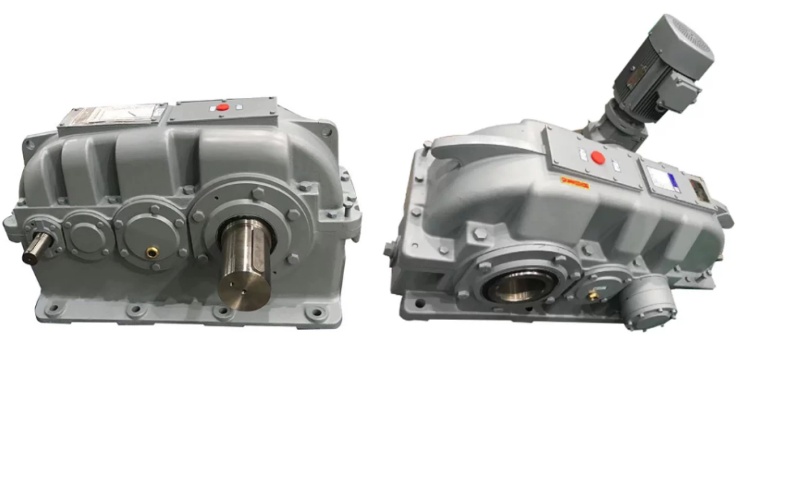
DCY hard toothed reducers are a common choice on mining, metallurgical, and cement production lines in Ulanqab.
The DCY series is a two-stage or three-stage hardened cylindrical gear reducer designed specifically for impact loads and continuous operation. In Ulanqab, the temperature can reach -30 ° C in winter and severe sandstorms in summer. Therefore, the selection should not only consider the transmission ratio and torque, but also the oil viscosity, sealing weather resistance, and heat dissipation in cold climates.
Seven parameters for selecting the transmission gear DCY hard tooth surface cylindrical gearbox
| Parameter | What to Check | Risk If Ignored |
|---|---|---|
| 1. Actual ratio deviation | Compare motor rated speed with driven-machine speed; DCY common ratios are 8.2–236 | Over 5% deviation causes insufficient torque or overspeed |
| 2. Permissible radial load | Convert chain/sprocket overhung loads into equivalent load | 30% overload can break the output shaft |
| 3. Starting & peak torque | For frequent reversing or loaded starts, check 1.8–2.5× starting torque against allowable overload | Rated torque alone is not enough |
| 4. Ambient temperature | Standard range is −10°C to 40°C; use low-temp grease/heater and FKM seals below that | Seal leakage and startup wear |
| 5. Efficiency & heat | Multi-stage oil-bath efficiency is about 94–96% | Heat raises oil temperature and lowers film strength |
| 6. Mounting & load direction | Confirm foot or flange/hollow-shaft mounting and end support | Eccentric loads cause shaft deflection |
| 7. Service factor (f.s.) | Use 1.75+ for severe mining shock, not just the catalog 1.25–1.5 | Pre |
Real Case: DCY315-50 Iron Ore Conveyor in Ulanqab
| Item | Data |
|---|---|
| Reducer | DCY315-50, ratio 50, center distance 315 mm |
| Conveyor | 120 m long, 1.2 m wide, iron ore at ~2.4 t/m³, 450 t/h |
| Installation | Outdoor, winter minimum −28°C |
| Measured input/output speed | 1,480 / 29.6 rpm |
| Measured output torque | 18.2 kN·m vs. 15 kN·m rated unit torque |
| Current | 12–15% above theoretical value |
| Oil temperature | 68°C after 6 h; 79°C summer max; 21°C winter |
| Failure at 8 months | Input oil seal seepage; slight scoring on first-stage pinion |
| Root cause | Cold oil viscosity ~1,500 cSt at startup; hot oil ~68 cSt, insufficient film strength |
| Fix | PAO 220 synthetic oil (~120 cSt cold), 80 W sump heater preheat to 10°C, double-lip FKM input seal |
| Result | 14 months continuous operation, no seepage or gear damage; max oil temperature 71°C |
Three Overlooked Details
Check motor flange and reducer interface tolerances. Batch variation in shaft diameter causes misalignment and extra bending. Use laser alignment and keep coaxiality within 0.05 mm.
Relocate the breather for dusty sites. An upward breather without a dust filter pulls abrasive dust into the housing. Use a side-mounted breather with an air filter and clean the element every three months.
Set an oil sampling schedule. Check oil every 500 h and replace every 2,000 h. For continuous lines, add online oil monitoring or ferrography to detect wear trends early.
Bottom line: choose DCY by load profile, environment, service factor, and thermal margin—not by brand or catalog model alone. For cold, dusty mining duty, the correct DCY hardened gear reducer selection is the real lifetime guarantee.
Target long-tail keywords: DCY hardened gear reducer selection, cold climate gearbox oil viscosity, DCY315-50 conveyor drive, service factor for mining gearboxes, Ulanqab mining gear reducer case.