
NMRV Gearbox Shaft Types – Single, Hollow & Double Output Shaft Advantages | Worm Reducer Selection
H1: NMRV Gearbox Shaft Types – Single, Hollow & Double Output – Which One Do You Need?
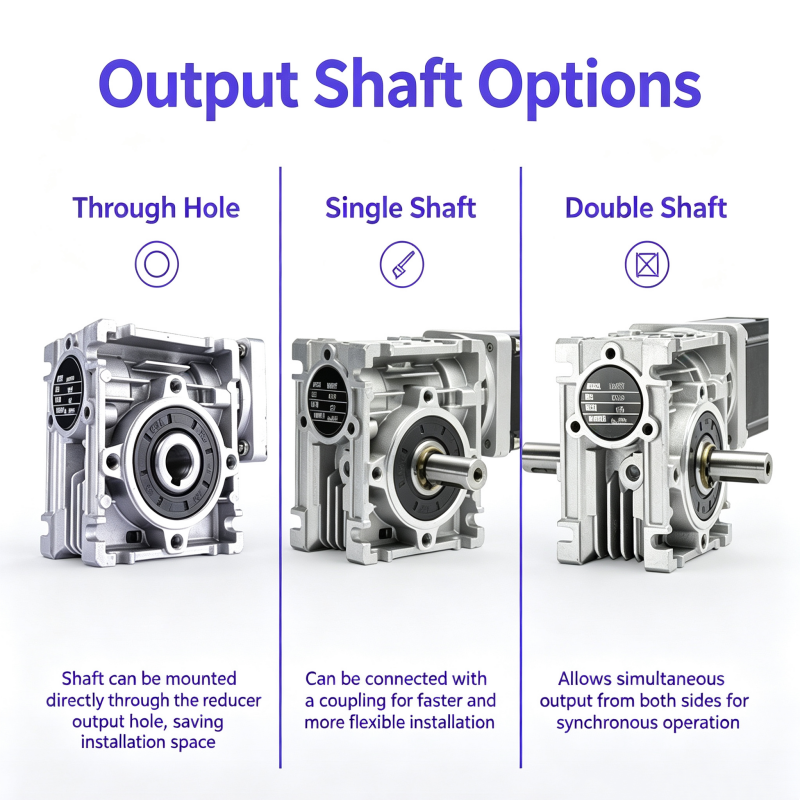
NMRV worm gearboxes offer three output shaft configurations: single shaft (solid), hollow shaft (bore), and double shaft (bidirectional) . Each serves different application needs.
H2: Single Output Shaft (AS) – Standard & Cost-Effective
What it is: A solid shaft extending from one side of the gearbox, typically with a keyway for coupling connection
Advantages:
Simple & reliable – direct connection to driven equipment via coupling or sprocket -
Most cost-effective – standard configuration, lowest cost
Easy maintenance – straightforward coupling alignment and replacement
H2: Single Output Shaft (AS) – Standard & Cost-Effective
What it is:A solid shaft extending from one side of the gearbox, typically with a keyway for coupling
connection
Advantages:
Simple & reliable – direct connection to driven equipment via coupling or sprocket
Most cost-effective – standard configuration, lowest cost
Easy maintenance – straightforward coupling alignment and replacement
Best for: General industrial applications – conveyors, mixers, agitators, packaging machinery
H2: Hollow Output Shaft – Space-Saving & Direct Mounting
What it is: A hollow bore output that slides directly onto the machine‘s solid shaft
Advantages:
●Saves space – no coupling needed, reduces overall equipment length
●Direct shaft mounting – slides onto conveyor roller shafts or load equipment shafts
●Simplifies alignment – eliminates coupling misalignment issues
●One housing, two options – same frame size supports interchangeable hollow and solid shafts
H2: Double Output Shaft (AB) – Bidirectional Power Transmission
What it is: Solid shafts extending from both sides of the gearbox, enabling power take-off in two directions
Advantages:
●Dual-sided drive – power two machines or two sides of one machine from a single gearbox
●Balanced loading – improves axial force distribution and bearing load balance
●Flexible layout – connect equipment on either side, simplifies system design
●Redundant capability – if one side is damaged, the other can still operate
Best for: Dual-drive conveyor systems, synchronized dual-side equipment, textile machinery, assembly lines where power needs to be delivered to both sides