
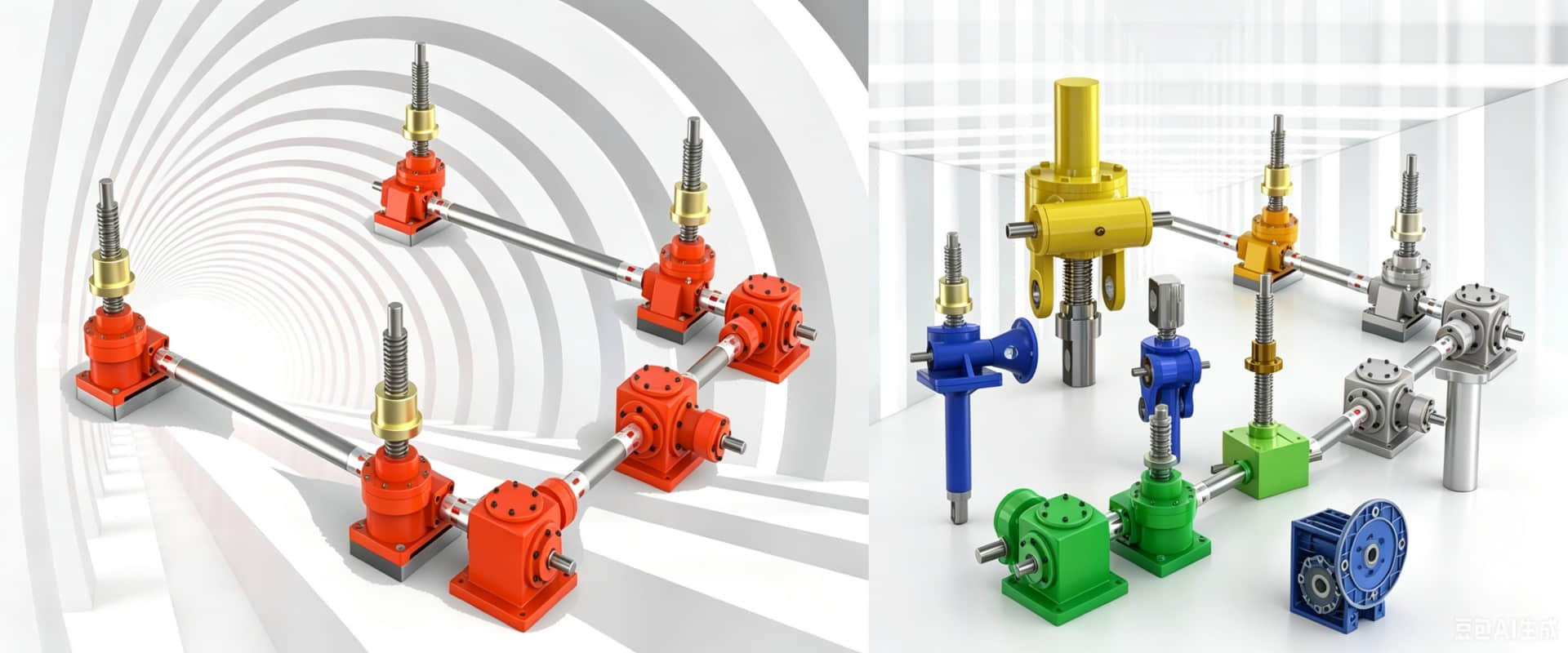
How to choose the appropriate brake gear motor and reduction motor
H1: Brake Motor Selection Guide: How to Choose the Right Brake for Stopping and Holding
A brake motor performs two distinct functions that must be specified separately:
Holding: Keeping a stationary load stationary against gravity or external force.
Stopping: Decelerating a moving load within a defined time or distance.
Conveyors and machine tools usually need holding; hoists, cranes, and high-inertia loads need both. If you specify only one number, you may get a brake that holds safely but cannot stop the load, or one that stops well but wears rapidly under holding duty.
H2: Step 1- Calculate the required braking torque for the three-phase motor
Using the rated torque of the motor as a baseline, then applying a safety factor that matches the load type:
Required braking torque (Nm)=9550 × (kW ÷ RPM) × safety factor
| Load / Application | Safety Factor (SF) | Typical use |
|---|---|---|
| General machinery, conveyors | 2 – 3 | Horizontal loads, moderate inertia |
| Hoists, cranes, vertical lifts | ≥ 3 (not below 3) | Gravity-loaded axes; fail-safe mandatory |
| Compressors, high-inertia loads | 5 – 6 | Rapid stops, large rotating mass |
For a 75 kW, 4-pole motor (≈1480 rpm), base torque is about 484 Nm; with SF 3, specify a brake rated ≥ 1450 Nm for a hoist application. Never select a brake motor for lifting with SF below 3.
H2: Step 2 — Choose the brake type: DC, AC, or spring-applied
H2: Step 3 — Match duty cycle and environment
Duty cycle: Frequent starts/stops belong to S3 / S4 duty; load inertia and starting frequency become the dominant selection factors, not just rated power
IP rating: For outdoor or dusty sites, specify IP55 minimum; IP65 for mines and dust-heavy environments
Thermal protection: PTC thermistors are recommended on larger frames (≥160) to protect the winding under high braking energy
H2: FAQ: Brake motor selection questions
H3: What is the most common brake motor selection mistake?
Treating brake voltage as identical to motor voltage, or estimating brake torque from kW alone without calculating load inertia and stopping time. Both lead to brakes that either fail to release or wear out prematurely
H3: Can I use a standard brake motor for a hoist?
Only if the brake is spring-applied (fail-safe) and the safety factor is at least 3. A brake that requires power
to remain engaged is not acceptable for lifting duty.
H3: What happens if the brake torque is too low?
The load may not hold at standstill, or stopping distance exceeds the safe limit. On a vertical axis, this
means load slip or drop. On a conveyor, it means overshoot and product damage.
H3: Do I need a separate rectifier for a DC brake?
Some DC brake motors have a built-in rectifier in the terminal box; others require an external rectifier. This must be confirmed at the specification stage, because incorrect supply wiring can overheat or burn out the brake coil.
H2: Not sure which brake torque your application needs?
Send us four details and we will size the brake for you:
Application type (conveyor / hoist / machine tool / other)
Motor power and poles (kW, rpm)
Load type (horizontal / vertical / high-inertia)
Stopping frequency and required stopping time