
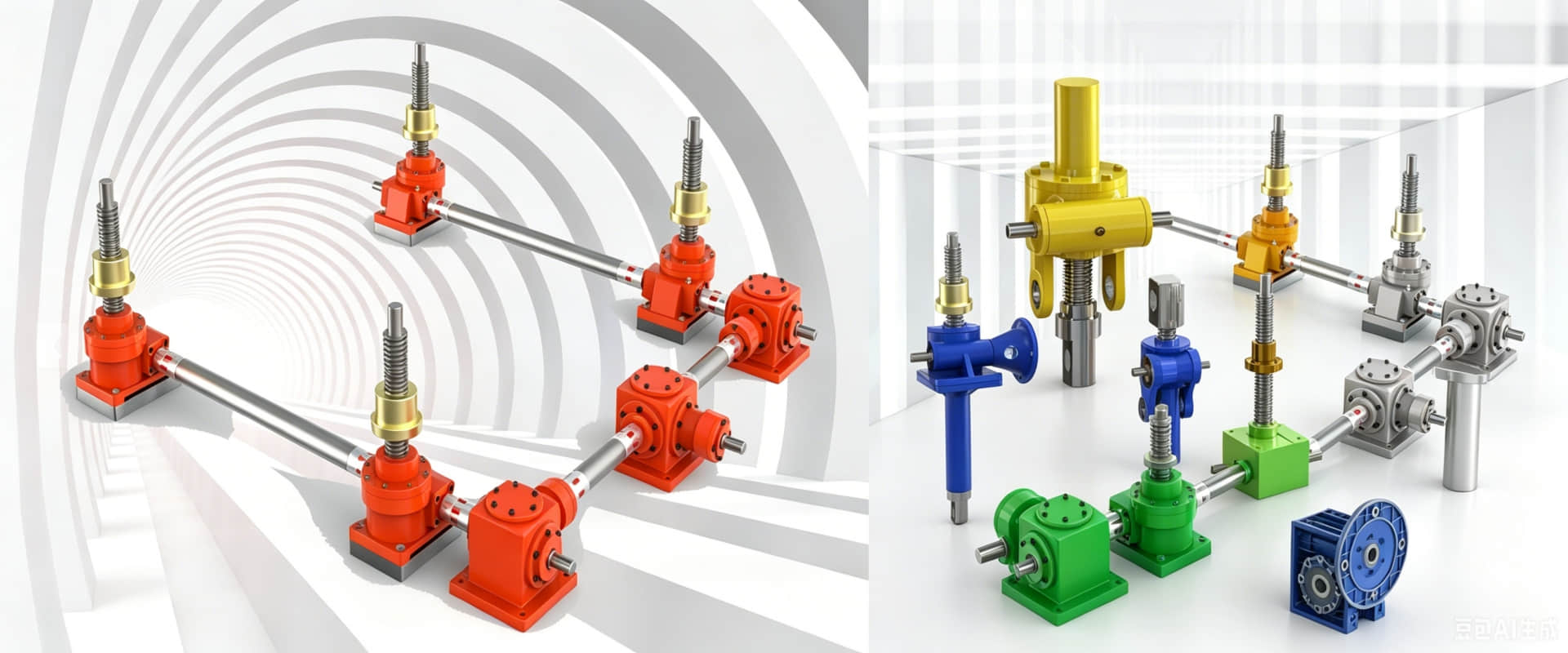
lightweight gear motor technology trends
**Lightweight Gear Motor Technology Trends: Smaller, Lighter, Stronger**
Lightweighting is one of the core directions in gear motor technology development.
From aerospace and robotic joints to portable power tools, every gram of weight reduction
means higher energy efficiency, longer battery life, and more flexible structural design.
Currently, three major technological paths—material innovation, structural topology
optimization, and integrated design—are jointly driving gear motors into the "weight era."
**Trend 1: Material Innovation—Aluminum Alloys, Magnesium Alloys, and Engineering Plastics**
Traditional cast iron housings are being replaced by high-strength aluminum alloys (such as 7075-T6)
and magnesium alloys, reducing weight by 40-60% while maintaining rigidity. Small planetary and worm
gear reducers are beginning to use special engineering plastics such as PEEK and glass fiber reinforced nylon
to manufacture gears and internal gear rings, further reducing inertia and weight, and possessing
self-lubricating and noise-reducing characteristics.
**Trend 2: Topology Optimization and Additive Manufacturing**
Through finite element analysis and topology optimization algorithms, redundant materials outside the
force path are removed to generate biomimetic skeletal, hollow lattice structures in the housing.
Combining 3D printing technologies such as selective laser melting (SLM) with direct manufacturing
can further reduce the shell weight by 20-35% and integrate internal cooling channels,
achieving integrated structure and heat dissipation.
**Trend 3: High Torque Density Motors and Thin Gearboxes** Axial flux motors (disc motors)
and coreless motors, with their flat structure and high torque density, are becoming the mainstream
choice for lightweight joints. When paired with harmonic or RV gearboxes, the overall length is significantly
reduced. Thin gearboxes (such as cycloidal pinwheels and strain gauge gears) have large transmission ratios,
fewer parts, and weigh only one-third of a spur gearbox with the same torque.
**Trend 4: Integration Eliminates Redundant Parts** Integrating the motor shaft with the gearbox input gear,
or directly integrating the measured gear disc and encoder onto the gearbox output flange, reduces couplings,
transition flanges, and additional bearings. Integrated drive modules mount the servo driver directly
on the motor housing, eliminating electrical cabinets and long cables, resulting in significant system-level weight reduction.
**Trend 5: Hollow Shafts and Hollow Cable Routing** Gearboxes employing large hollow through-holes
allow wiring harnesses, optical paths, or pneumatic tubing to pass through the center, eliminating
the need for external cable chains and supports. This is particularly crucial for robot wrists and bionic joints,
not only reducing overall weight but also increasing effective payload space.
**Application Prospects** Lightweight geared motors are empowering the next generation of robots,
drones, exoskeletons, and electric aircraft. Suppliers with integrated capabilities in materials,
design, and precision manufacturing will gain a competitive edge.
**We Offer Customized Lightweight Geared Motor Solutions** From aluminum/magnesium alloy
housings and topology-optimized designs to high-performance axial flux motor integration,
we provide a one-stop service from concept to mass production, tailored to your extreme
requirements for weight, torque, and volume.